2026 Illinois primaries: The Diminishing Returns of the $50 Million Hammer
A roadmap for the midterms: Lessons from the front lines of the Illinois spending wars.


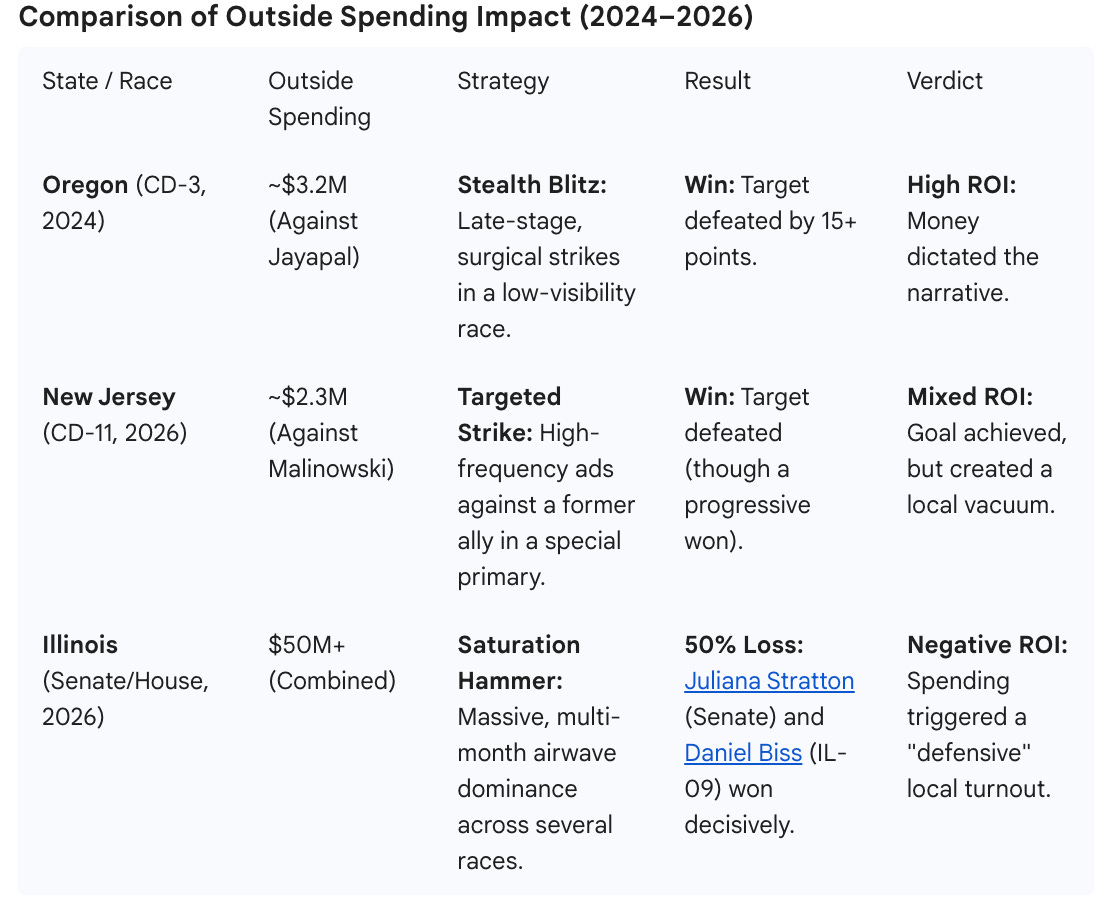
In the high-stakes Illinois Democratic primary on March 17, 2026, national special interest groups unleashed an unprecedented financial barrage: over $50 million combined from AIPAC-linked super PACs and the crypto industry’s Fairshake PAC aiming to shape outcomes in the Senate race and several Chicago-area House contests. The result? A bruising 50% failure rate that exposed the limits of mega-spending in today’s polarized, media-saturated environment.
In 2024 and early 2026, groups like AIPAC and Fairshake successfully used a 'stealth blitz' to topple candidates in states like Oregon and New Jersey. But in Illinois, they encountered a unique obstacle: a high-visibility counter-narrative. By the time the ads hit, Juliana Stratton and JB Pritzker
had already framed the choice not as a policy debate, but as a defense of 'home-grown' leadership against 'national lobbyists.' Money can win a quiet race, but it often loses a loud one
The most glaring defeat came in the marquee U.S. Senate primary to replace retiring Sen. Dick Durbin. U.S. Rep. Raja Krishnamoorthi entered as a heavy favorite with a formidable war chest, bolstered by roughly $10 million in anti-opponent spending from Fairshake targeting Lt. Gov. Juliana Stratton. Yet Stratton secured a decisive victory, winning around 40% to Krishnamoorthi’s 33% (with Rep. Robin Kelly trailing). Beyond being a loss, it was a 6-point triumph for Stratton despite the onslaught of attack ads painting her as out-of-step on issues like crypto regulation and national security.
The failure of the $50 million hammer in Illinois wasn't just a fluke of Midwestern stubbornness; it was a demonstration of the Immunity Threshold. In lower-information environments—like the 2024 Oregon 3rd District primary—a 'stealth blitz' of $2 million can reshape a race before the target even realizes they’re under fire. But when spending hits $50 million in a high-profile market, it ceases to be 'information' and becomes 'intrusion.' At that volume, the ads trigger a Backlash Tax: voters stop listening to the message and start questioning the messenger. In Illinois, the hammer didn't just miss; it swung so hard it broke the tool.
What flipped the script? Gov. J.B. Pritzker’s formidable “Pritzker Shield.” Through his Illinois Future PAC and direct endorsements, Pritzker reframed the race as a classic Illinois vs. outsiders battle: local pride and grassroots ties against “national lobbyists” flooding the airwaves. Stratton’s campaign leaned into this narrative, portraying the deluge of outside money as proof of undue influence. Voters responded, defaulting to familiar “identity and endorsement” cues—who do I know and trust locally?—over a barrage of negative ads.
This dynamic repeated in key House races. In IL-09, AIPAC-backed efforts (part of the group’s $21+ million statewide push via affiliated groups) targeted candidates but backfired. Evanston Mayor Daniel Biss won the nomination despite heavy attacks, turning the “AIPAC target” label into a progressive badge of honor that energized base voters. Similar patterns emerged elsewhere, where being on the receiving end of millions in opposition spending galvanized rather than deterred support.
The data underscores a new mathematical reality in American politics: diminishing or even negative returns on attack-ad saturation. Sources like Punchbowl News highlighted AIPAC’s $21 million investment across four House races, yet the group secured wins in only about half. Fairshake’s aggressive plays, including millions against Stratton and others, yielded losses in high-profile contests. In oversaturated media markets, each additional million yields less voter persuasion and more resentment toward perceived “dark money” intrusion.
This Illinois primary serves as the first major 2026 test of whether unlimited spending can still dictate Democratic primaries. The verdict: No. As voters grow weary of endless attack ads and prioritize local authenticity, national special interests risk triggering backlash rather than dominance. Heading into the midterms, campaigns may rethink reliance on mega-donors, favoring targeted grassroots and local alliances instead. The $50 million hammer swung hard—but it didn’t land cleanly.