

A Cynical Exception: The Rise of the American Archipelago
New data reveals a nation that has moved past simple polarization into a state of “moral excommunication.” More Americans now view their own neighbors as “bad people.”


For decades, the standard lament of the American intellectual was “polarization,” a tidy, if somewhat clinical term suggesting two magnets facing the wrong way. We spoke of “reaching across the aisle” as if ideological distance were a quick-fix geography issue. But the 2026 Pew Research Center’s 25-country survey suggests we are no longer dealing with something more than a political rift.
The United States has become the cynical exception. It is the only nation surveyed where a majority of adults (53%) describe the morality of their fellow citizens as “bad.” While nations like Kenya and Indonesia are experiencing a “softening” of moral judgment—dropping 29 points in their condemnation of divorce, for example, over the last decade—America has hardened. We are no longer a people divided by policy; we are repulsed by one another’s existence.
Geography of Hate: The Regional “Big Sort”
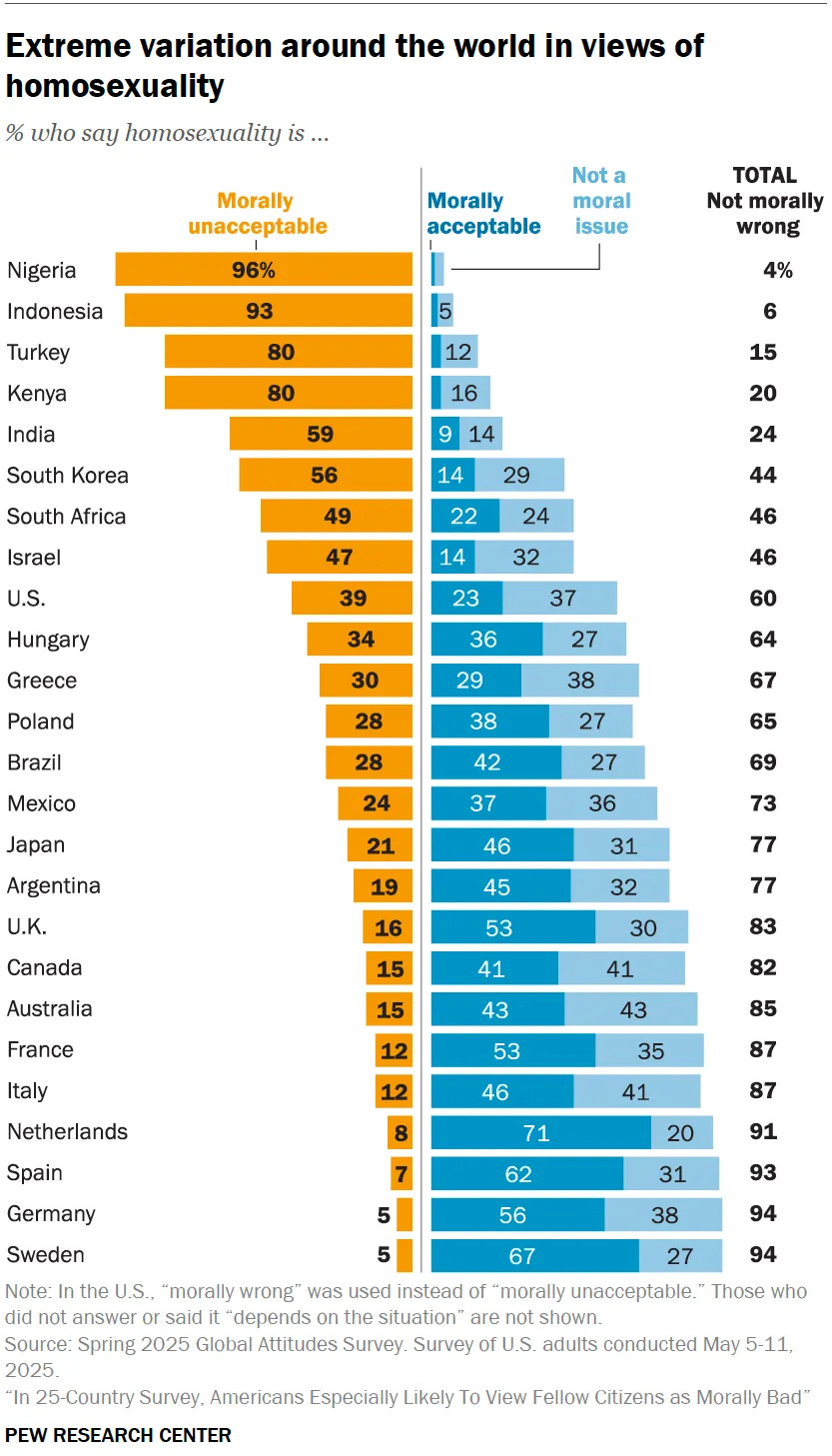
This national “badness” rating is a statistical exception and exists almost nowhere as a moderate middle. Instead, it reflects our radicalized blue/red ecosystem. In the “Acela Corridor” and the Pacific Coast, moral disapproval of homosexuality mirrors the secular consensus of Sweden (5%).
By contrast, according to the survey, 39% of U.S. adults view homosexuality as morally unacceptable. In the interior American South and Rust Belt, those figures remain anchored in pre-Obergefell numbers, often exceeding 60%. Not great. But at least better compared to Indonesia (93%) and Nigeria (96%). Still. 60%. In 2026.
This split represents a power shift in its rawest form. When morality geographically calcifies, federalism ceases to be a functional system of governance, becoming a jurisdictional arms race. Americans are no longer just moving for jobs; they are moving to escape “ethical pollutants” such as neighbors with moral frameworks they find abhorrent. We’re in effect witnessing secession by zip code, where the “other” is only ever encountered through a screen, allowing them to remain a permanent caricature.
Reports from early 2026 highlight that Chicago has become a primary destination for LGBTQ+ people fleeing hostile state environments. The city’s real estate data from March 2026 shows a marked increase in LGBTQ+ individuals relocating from out-of-state. Unlike previous years, where moves were often internal (moving between neighborhoods), the current trend is defined by interstate migration.
And so a new behavioral pattern has emerged where arrivals are renting for 1–2 years to ensure the city is a long-term “fit” before committing to homeownership, a sign that these moves are often reactive and urgent.
Illinois’ status as a protector of transgender civil rights and gender-affirming care has made Chicago a “mecca” for those in surrounding states with restrictive healthcare laws.
The Transgender Exodus: Nearly 1 in 10 transgender adults moved to a new state in just the seven months following the November 2024 election.
Top “Fled” States: Independent migration maps identify Texas as the state with the highest number of LGBTQ+ departures.
Primary Drivers: Over 90% of those moving cite LGBTQ+ legal protections and the presence of a supportive community as their top reasons for choosing a new destination.
The Sectarian Divide: Why the “Good Man” Myth Died
The neighborly feel-good collapse is further visible in the disintegration of Christian consensus. Data reveal a staggering 25-point gap in moral judgment: 59% of Protestants label homosexuality as morally wrong, compared to just 34% of Catholics.
For a century, the shared “Judeo-Christian” ethic served as a stabilizing myth, a collective pool of values. But in 2026, when a Protestant neighbor views a Catholic neighbor’s permissiveness not as a difference of opinion but an “unethical” failure of faith, social fabric weakens. In 13 of the 25 countries surveyed, Protestants and Catholics hold similar views. Only in the U.S. do these groups appear to be moving in opposite directions, turning pews into battlements.
The Consumerist Canon: Faith as a Political Accessory
The second fracture in the “good man/bad man” myth is a transition from inherited faith to curated conviction. Historically, local parishes or congregations served as “purple” spaces, a rare geographic constant where a laborer and a local business owner shared a hymnal regardless of their vote.
Now, we’re seeing the rise of theological sorting. Americans are increasingly “shopping” for houses of worship that provide a moral seal of approval for their pre-existing political identities.
The Result: Instead of religion acting as a check on political tribalism, it has become its megaphone.
The Impact: When a neighbor switches churches because yours isn’t “radical enough” or is “too woke,” they aren’t just changing their Sunday routine; they’re self-innoculating based on the impossibility of shared ground. We have moved from “we disagree on some interpretations of scripture” to “you are practicing an untenable version of my God.”
Within this environment, the “good” cannot exist in the opposite camp because their very presence is seen as an act of heresy against the “correct” moral order.
The Outrage Industrial Complex
So, why exactly is the U.S. a global outlier? The reason may reside in the fact that we have the world’s most advanced “outrage infrastructure.” In the American attention economy, “moral badness” is a high-yield asset.
Social media algorithms have discovered that indignation travels faster than affinity. When a traditionalist posts a critique of modern norms, the algorithm doesn’t show it to their peers to build community; it “rage-baits” college-educated progressives who find the view “immoral.” This creates a narrative collapse. We don’t see the average American; we see the most extreme, most “bad” version of our opposition.
In the UK (BBC) or Japan (NHK), the mandate is often "inform and educate," which provides a shared set of facts. In the US, news is often "infotainment." When news competes with TikTok and Netflix for retention, it must adopt high-arousal triggers. Truth becomes secondary to engagement metrics.
The Inversion of Sin
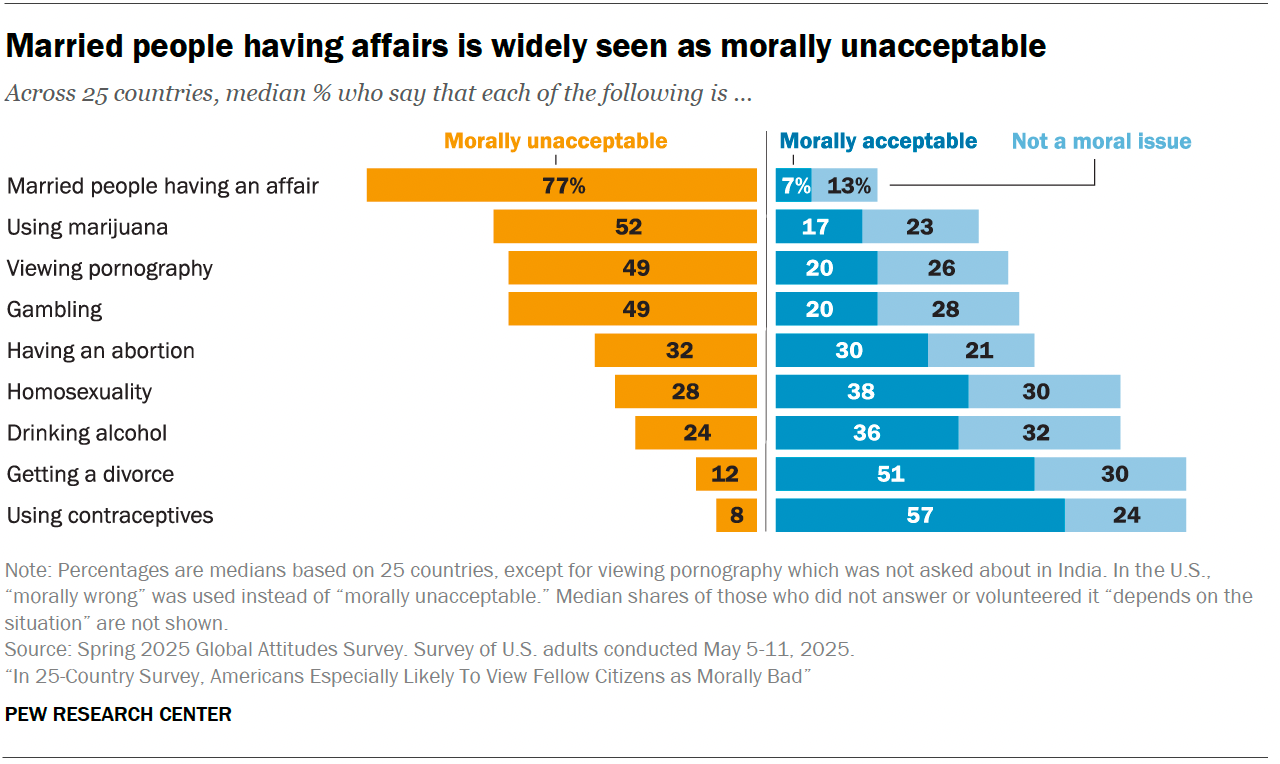
But all is not lost. There’s a revelation hidden in the Pew data. Americans aren’t actually more moralistic; they are more punitive. On “hard” vices, Americans are surprisingly permissive. We are among the most accepting of marijuana (only 23% find it wrong) and gambling (29%). We rank middle-of-the-pack on abortion.
In other countries, “morality” is a set of rules you abide by. In America, it has become a social clearance level. We decouple “sin” from “action” and attach it to “identity.” In other words, we don’t care if our neighbor gambles, smokes, or cheats; we care which side they’re on while they do it. We have traded a “Code of Conduct” for a “Code of Allegiance.” We’re not judging what people do; we’re judging who they are.
What does it mean?
As we start girding our loins for the 2028 election cycle, this growing perception of a “trust tax” may well render traditional campaigning obsolete. Prepare for more fabricated outrage and faux forensics:
The Extinction of the “Swing Voter.” If 53% of the country views the other half as “morally bad,” the “undecided” voter is a myth. 2028 may not be about persuasion but about mobilization through fear. Candidates promise less prosperity; instead, they promise protection from the “evil” neighbors across the state line. During the September 10, 2024, presidential debate, Donald Trump made a viral and controversial claim regarding Haitian immigrants in Springfield, Ohio. While discussing immigration policy, Trump stated:
“In Springfield, they’re eating the dogs—the people that came in, they’re eating the cats. They’re eating—they’re eating the pets of the people that live there.”
Lawfare as Standard. In a low-trust society, the ballot box is no longer seen as a final arbiter. If “bad actors” win, “good folks” feel morally obliged to subvert the result. Expect 2028 to be defined by preemptive litigation and wholesale refusal to recognize the moral legitimacy of the opposition’s victory.
Lest we forget the January 6, 2021 US Capitol attack by a mob of supporters of then-President Donald Trump. The rioters’ primary goal was to disrupt a joint session of Congress convened to certify the results of the 2020 presidential election, which Trump had lost to Joe Biden.
The “Moral Gated” Campaign. Candidates now lean into education triggers. Progressives frame elections as an enlightened defense against an “undereducated cult,” (remember Hilary’s ‘deplorables” quip), while conservatives frame it as a defense of “traditional values” against “elite decadence.”
During the 2021 Virginia Gubernatorial Election between Republican Glenn Youngkin and former Democrat Governor Terry McAuliffe, education became a defining issue. Youngkin capitalized on parental frustration over COVID-19 school closures and "Critical Race Theory" (CRT).
The Generational Cliff: Gen Z and the Institutional Void
The cynical shift is not merely a relic of Baby Boomer culture wars; it’s also accelerating among the young. Pew finds that younger Americans (18–39) are more likely than their elders to view fellow citizens as morally bad (57% vs 50%).
This is an uncomfortable institutional lens. Younger generations have come of age in a world where “referee” institutions—local news, nonpartisan civil service, even neighborhood associations—have effectively been hollowed out. Without mediating layers, the individual is left to face the “other” in a raw state.
For a 22-year-old entering the workforce in 2026, a “morally bad” neighbor isn’t just someone with a crappy lawn sign; they’re a threat to the 22-year-old’s ability to work, marry, or even exist in public space.
The Reckoning: Can the Archipelago Be Rejoined?
The question for 2028 and beyond is whether a nation can survive as a collection of islands. The second-order effect of low trust is a catastrophic decline in national resilience. When a society views its internal components as a moral hazard, it loses the ability to mobilize for external threats.
If we cannot agree that our neighbors are fundamentally decent, we cannot ask for their sacrifice. We cannot build a high-speed rail that crosses “enemy” territory; we cannot fund a school system that educates “bad” children; we cannot maintain a defense force composed of people we find irredeemable.
The path forward isn’t a bridge back to a mythical past but a map for how to live as strangers who simply agree not to burn the shared house down. As the U.S. enters the 2028 cycle with 53% of its population viewing the “other” as morally lacking, we must start confronting what it means to be dysfunctional yet united states.