

Mahagonny Comes to Mexico: The 96-Year-Old Opera That Explains 2026
Mexico City’s first-ever staging of Weill and Brecht’s savage capitalist satire arrived at the Palacio de Bellas Artes nearly a century late. Its timing couldn’t be more precise.


Three fugitives from justice build Mahagonny, a city in the American desert, as a trap for gold miners: a city of limitless pleasure, where everything is permitted as long as you can pay. The boom arrives. Corruption deepens. The city’s single commandment reveals itself in a trial scene that functions as the opera’s moral engine: a man is sentenced to death for the crime of having no money. Mahagonny burns.
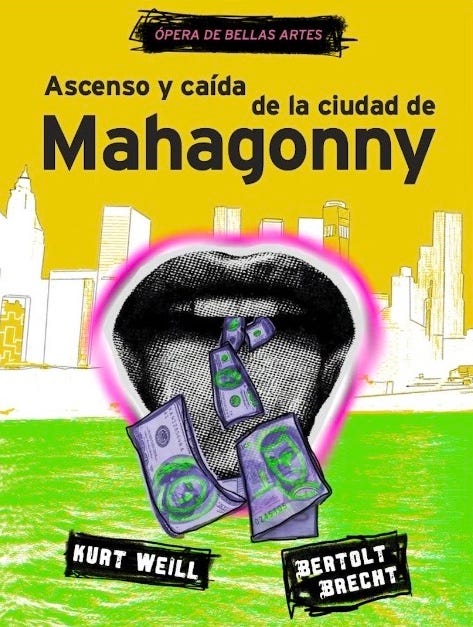
In Marcelo Lombardero’s staging of Ascenso y caída de la ciudad de Mahagonny at Mexico City’s Palacio de Bellas Artes, digital panels frame the action like a live broadcast, turning Brecht and Weill’s 1930 opera into something resembling a reality show about the end of civilization. The audience watches a fictional city devour itself on screens while sitting inside the most extravagant Art Deco theater in the Americas. The dissonance is exquisite. It’s also the point.
The opera premiered at Bellas Artes on March 22, 2026, ninety-six years after its world premiere in Leipzig. Mexico had never staged it. The question isn’t why it took this long. It’s why the delay made the opera more dangerous, not less.
The Pleasure City’s Rules
Lombardero, an Argentine director who now leads Mexico’s Compañía Nacional de Ópera, drew the contemporary parallel explicitly in his press conference. He described the opera’s internal logic as the “every man for himself” doctrine: “If you want money and you see someone with it, take it. If you see a house and you like it, enter it.” He told La Jornada he sees that logic “in so many places today.”
The musical texture reinforces the instability. Conductor Srba Dinić, who has led seventy-eight operas, told La Jornada he’d never encountered anything comparable. The score moves from a Bach fugue to Berlin cabaret inside a single act. The orchestra requires banjo, mandolin, saxophones, bandoneón, and a fortepiano that plays almost the entire work. Weill’s music doesn’t let you settle into any genre. That refusal of comfort is Brecht’s dramaturgical strategy made audible.
The Bellas Artes is a hauntingly perfect backdrop for Mahagonny, as the Carrara marble building itself is a monument to the very tensions Brecht and Weill satirized. The most direct and unintended link to the opera within the theater is Diego Rivera’s mural, Man, Controller of the Universe (1934). Much like Mahagonny, Rivera’s mural is a critique of capitalist decay, depicting the “crossroads” of humanity, contrasting a chaotic, diseased, and war-hungry capitalist world with a structured socialist utopia. The work’s was originally commissioned for New York’s Rockefeller Center but was destroyed by the Rockefellers before completion because Rivera refused to erase a portrait of Lenin. Rivera’s depiction of “the wealthy” playing cards and drinking while the world burns echoes the hedonistic, money-driven citizens of Mahagonny who are “permitted everything as long as they can pay.”
What the Coverage Missed
The Palacio de Bellas Artes isn’t a fusty venue; it has hosted some of the most volatile and triumphant moments in 20th-century art. In 1951, Maria Callas performed Aida at Bellas Artes. In a legendary diva moment she interpolated a unwritten high E-flat at the end of the Triumphal Scene. The note was so powerful and unexpected that it reportedly sent her tenor, Kurt Baum, into a rage, while the audience erupted into a “madhouse,” cheering as if they were at a bullfight.
Frida Kahlo’s connection to the house is most famous for her funeral in 1954. Her body lay in state in the lobby, and a major political stir was caused when a Communist flag was draped over her coffin. This act led to the immediate firing of the director of the National Institute of Fine Arts (INBAL), as the government at the time was trying to distance itself from the very Marxist ideologies that Rivera’s murals (and Brecht’s Mahagonny) celebrate.
Conventional wisdom treated the 2026 CDMX premiere as a milestone: Mexico’s first Mahagonny, a cultural event, a triumph. Opera World’s Federico Figueroa called the production “splendid.” INBAL’s subdirectora artística, Lilia Maldonado, praised it as a work that “speaks to very current themes.” All accurate. If insufficient.
What no one adequately examined is why Mexico’s ambitious national opera company, a state-funded institution under the Secretaría de Cultura, chose this particular work to open its 2026 season and what that institutional decision reveals. This isn’t some rinky-dink company playing it safe with, say, another Carmen. The season’s opening salvo is a German-language Marxist satire about capitalism’s self-destruction, performed in a country whose own economic contradictions have sharpened over the past decade. The repertoire choice is itself a political statement, even if nobody on stage would say so.
An Argentine Director, a Pan-American Production, and a Quiet Institutional Shift
The deeper dynamic is perhaps more structural. This production didn’t originate in Mexico. Lombardero first staged it at the Teatro Municipal de Santiago de Chile in 2016, then took it to the Teatro Colón in Buenos Aires and the Teatro Mayor in Bogotá, where it won prizes. Its arrival at Bellas Artes represents the maturation of something the North Atlantic opera world hasn’t fully registered: a pan-Latin American opera circuit operating outside the traditional European axis, sharing productions, building regional talent, and choosing repertoire that speaks to the hemisphere’s specific conditions.
For many years, national opera houses have leaned on “standard” repertoire (think La Bohème or La Traviata) to guarantee ticket sales. Lombardero has stated his intent to build a tradition of premiering major 20th- and 21st-century titles at Bellas Artes. Last year saw Elektra by Richard Strauss and Dmitri Shostakovich’s Lady Macbeth of Mtsensk. By staging Shostakovich’s masterpiece, the Compañía Nacional de Ópera has asserted itself as a house of significant artistic daring. Oh, and they closed 2025 with Luciano Berio's Un re in ascolto ("A King Listens").
Eighty percent of the Mahagonny cast is Mexican. The 2026 season continues with De Falla, Werther by Massenet, Puccini’s Tosca, and closes with Mascagni paired alongside Luis Sandi’s Mexican modernist chamber piece, La Señora en su Balcón. The opera studio will stage Olga Neuwirth’s Lost Highway. This is not the schedule of a house, coasting on standard Italian repertoire alone. The Mascagni pairing demonstrates this shift, eschewing the usual Pagliacci for the Sandi piece. Bellas Artes is a national institution using opera as a lens for contemporary political and social questions.
The institutional incentive is clear. Latin American opera houses that position themselves as producers rather than importers of serious repertoire gain artistic credibility and regional influence. The assumption that major Weill-Brecht productions belong to the German-speaking world quietly collapses when a co-production out of Santiago, Buenos Aires, Bogotá, and Mexico City delivers the work with the precision and political edge the material demands.
Opera That Runs on Gig-Economy Logic
Mahagonny’s governing principle reads differently in 2026 Latin America than it did in 1930 Weimar Germany. Brecht set his fictional city in the American desert because, to interwar Europeans, America represented the purest expression of capitalism’s logic: the place where money was the only law. Nearly a century later, that logic has migrated. The gig economy, remittance-dependent migration, and the commodification of daily life across the hemisphere have made Mahagonny’s premise less satirical and more documentary.
Lombardero’s staging underscores this. The digital screens function as a surveillance and entertainment apparatus simultaneously. Performers break the fourth wall to interact with the audience. The production was described by TechnoNoticias as creating the feel of a “reality show,” collapsing the boundary between spectacle and complicity.
Ronald Caltabiano, an American composer of contemporary classical music who attended the production, described the spatial experience: “Intentionally or not, the glorious house becomes a part of the story. One enters the gilded hall after walking through a red marble entryway, and the very first element of the opera is the 1970s video car chase.” Some of the action, he noted, took place in the aisles and in front of the orchestra, “thrust into the audience chamber.” The venue stopped functioning as a sanctuary from the story. It became part of the machinery the story describes.
What the Audience Understood
The orchestra was equal to the ambition. “Brilliant, literally brilliant where it could be, and lush and luxuriously supportive of the singers throughout. Even in the loudest orchestral moments the singers were never covered,” Caltabiano says. The cast functioned as a unified ensemble, but the performance that lingered was tenor Gustavo López Manzitti’s Jim Mahoney. Caltabiano singles him out as “the star among stars,” a singer who moved “from conversational clarity to soaring sustained passages that sent a chill up my spine. When allowed to, the audience roared their appreciation.”
In the end, Mahagonny burns. The city collapses under the weight of its own governing logic. The chorus marches with signs. At the 1930 Leipzig premiere, the audience rioted. In Mexico City in 2026, the audience did something more reserved. They cheered. And shouted bravos. But most remained in their seats. Caltabiano, accustomed to standing ovations for anything that reaches a curtain call, read the stillness as a measure of the production’s impact: the audience was “completely appreciative but devastatingly moved by the story and perhaps the brilliance of the production.”
The difference between Leipzig and Mexico City is instructive. The riot meant the satire was shocking. Ninety-six years later, the production betrays something more unsettling. The satire is landing just a little too real.