

The Camouflage Doctrine: How a Texas Jury Rewrote the Rules of American Protest
A Fort Worth courtroom tested whether wearing black clothes to a demonstration can constitute terrorism. The answer has consequences far beyond north Texas.

Seth Sikes said he went to the Prairieland ICE detention center on July 4 because he wanted to bring joy to the people held inside. He pleaded guilty to providing material support to terrorists.
That contradiction sits at the center of the most consequential protest case in a generation. On March 13, a federal jury in Fort Worth convicted eight defendants on terrorism charges stemming from a chaotic nighttime demonstration outside the facility in Alvarado, Texas.
Benjamin Song was also convicted of attempted murder after an Alvarado police lieutenant was shot in the neck and shoulder. The officer survived. The convictions mark the first successful use of material support for terrorism charges against individuals the government linked to antifa, the decentralized far-left movement President Trump designated a domestic terrorist organization last September.
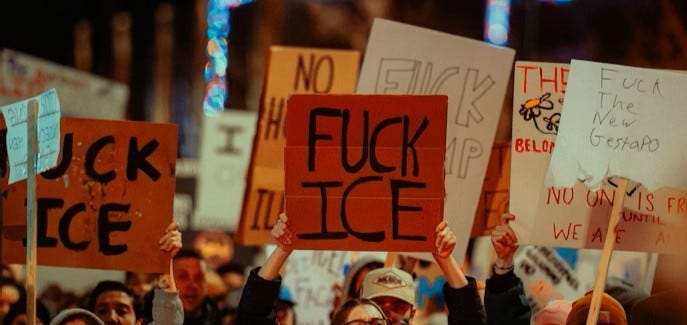
The verdict landed in a packed courtroom after two days of deliberation. Families wept. One defendant’s wife wore her wedding dress. Outside, supporters held signs. Inside, a legal framework that will reshape the boundaries of American protest was being stress-tested in real time.
What the Jury Actually Decided
The prosecution’s theory was straightforward and expansive. Assistant U.S. Attorney Shawn Smith argued that wearing all-black “black bloc” clothing to the demonstration constituted material support because it provided camouflage, making it impossible to distinguish who did what. Bringing firearms (legal under Texas law), carrying first-aid kits, using the encrypted messaging app Signal, and possessing anti-government literature all became evidence of a terrorist conspiracy. The fireworks intended as a “noise demonstration” were charged as explosives.
The jury largely agreed. Eight defendants were convicted of providing material support to terrorists, rioting, and conspiracy to use explosives. Four were acquitted on attempted murder charges, a partial rebuke suggesting jurors drew some line between presence and direct violence. Song, whom prosecutors cast as the cell’s ringleader, faces a minimum of twenty years. The others face between ten and sixty years. Sentencing is set for June.
Seven additional defendants had already pleaded guilty before trial, several of whom testified for the prosecution. Their accounts were revealing. Multiple cooperating witnesses told the court they expected nothing more than a noise demonstration that night and did not anticipate violence.
The Legal Architecture Behind the Charges
The Prairieland case would have been impossible a year earlier. Its legal foundation rests on two instruments issued in rapid succession last fall: an executive order on September 22 designating antifa as a domestic terrorist organization, and National Security Presidential Memorandum-7, signed three days later, directing federal agencies to prioritize investigations into what the administration calls organized campaigns of left-wing political violence.
NSPM-7 creates no new crimes. It designates no organizations with the legal force of the State Department’s foreign terrorist list. What it does is redirect the Joint Terrorism Task Forces, the IRS, and Treasury toward a set of ideological markers so broad they include anti-capitalism, criticism of immigration enforcement, and “hostility towards those who hold traditional American views on family, religion, and morality.” The memorandum instructs the Attorney General to identify “behaviors, fact patterns, recurrent motivations, or other indicia” common to targeted groups.
In practice, this means protest tactics familiar to anyone who has attended a demonstration in the past two decades can now serve as predicates for terrorism investigations. Encrypted communications. Coordinated clothing. Operational security. The Prairieland prosecution made each of these into evidence of conspiracy.
The Conventional Story and Where It Breaks Down
The administration frames Prairieland as a straightforward law enforcement success. A police officer was shot. Armed individuals coordinated an attack on a federal facility. Convictions followed. Attorney General Pam Bondi promised the verdict would not be the last.
The defense version is equally clean. Nine people attended a protest. One individual acted independently and with extreme violence. The rest are political prisoners charged under a framework designed to chill dissent.
Both narratives flatten something more complicated. A police officer was genuinely shot. Some defendants did carry rifles and body armor to what they described as a peaceful demonstration, a decision that strains credibility regardless of Texas open-carry laws. Cooperating witnesses testified they expected no violence, which suggests the group was fractured in its intentions. And several defendants were convicted of terrorism for conduct that amounted to wearing black clothes and being present when someone else pulled a trigger.
The camouflage doctrine, as the prosecution articulated it, converts proximity into complicity. That is the precedent the Fort Worth jury has now endorsed.
What Prairieland Actually Reveals
The deeper story is structural. The United States built a vast counterterrorism apparatus after September 11, designed to disrupt foreign-linked threats through material support statutes, financial surveillance, and task force coordination. NSPM-7 repurposes that infrastructure against domestic movements without passing new legislation. The legal tools remain the same. The targets have changed.
There is no federal list of domestic terrorist organizations equivalent to the State Department’s foreign roster, largely because the First Amendment makes one nearly impossible to create. The September executive order designating antifa as a domestic terrorist organization has symbolic force but no statutory teeth. What the government did instead was more effective: it used existing material support laws, layered them over a decentralized movement with no membership rolls or formal leadership, and argued that shared tactics constitute organizational structure.
The implications extend well beyond antifa. If wearing coordinated clothing and using encrypted messaging can constitute material support for terrorism, the doctrine is available for application against any group that organizes demonstrations using common protest methods. The question is not whether the government will use it selectively. The question is whether courts will let it.
The Road Ahead
Defense teams have signaled appeals on First Amendment grounds. The National Lawyers Guild called the case a vehicle for political persecution. Suzanne Adely, the Guild’s interim president, argued it was designed to make people in other cities think twice before protesting.
She may be right about the chilling effect, but that observation misses the larger mechanism. NSPM-7 also directs Treasury and the IRS to investigate nonprofits and donors whose activities are deemed to aid or abet domestic terrorism. Organizations working on immigration advocacy, racial justice, or government accountability now face a compliance environment where the definition of “support” is whatever the Justice Department says it is.
The Prairieland verdict arrived three days ago. Its consequences will take years to unfold. But the precedent is now live: a jury has accepted that presence, clothing, and ideological alignment can satisfy the elements of a terrorism statute originally written to dismantle al-Qaeda’s financial networks. The counterterrorism state has come home, and the courtroom where it happened was in Fort Worth.