

The Obliteration Trap: Trump’s Mirage of Total Victory
President Trump’s claims of total triumph mask a darker reality: the formalization of a conflict that has no intended end, and the quiet death of the constitutional power to declare war.


For the better part of a century, the American public has been fed a steady diet of technological triumphalism. We were promised that superior sensors, precision munitions, and “maximum pressure” would eventually yield decisive, clean conclusions to our myriad geopolitical entanglements. In the days following the Friday the 13th Kharg Island strikes, the rhetoric emanating from the White House has reached a fever pitch of finality. President Trump has characterized the operation as a “total obliteration” of Iranian capabilities, painting a portrait of a regime not just wounded, but functionally erased.
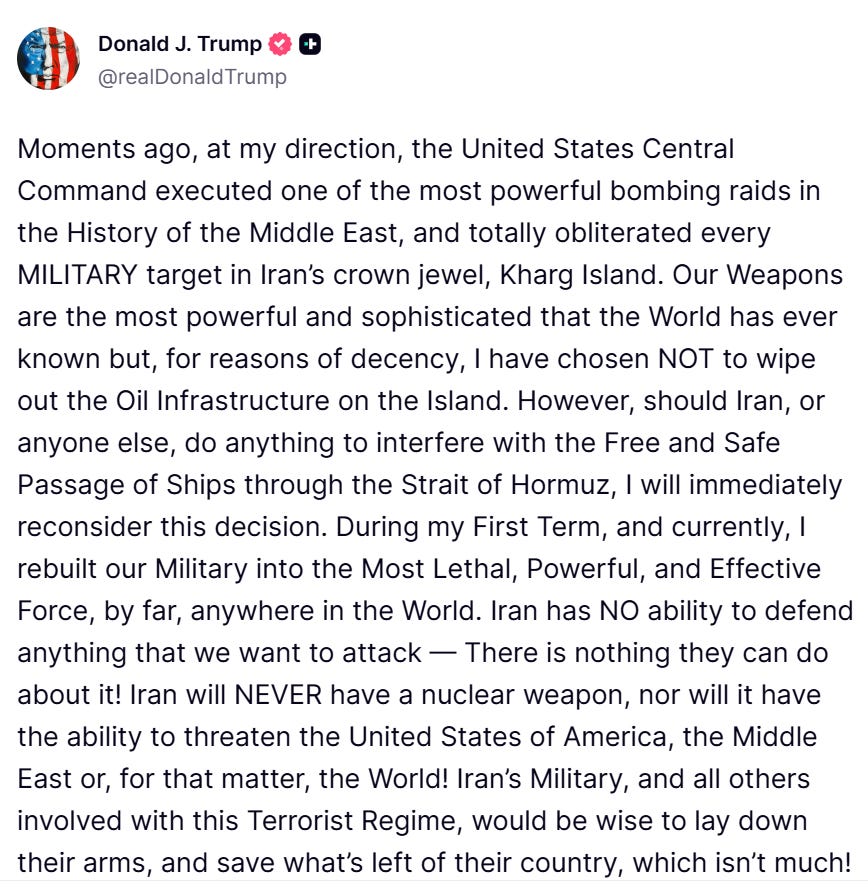
But beneath this language of cinematic victory lies a more corrosive reality: the formalization of a war designed to be perpetual. By declaring “total victory” while the Hormuz blockade persists and U.S. casualties continue to mount, the administration is not concluding a conflict. It is conditioning the American institution to accept permanent escalation as a new baseline of global diplomacy. We are being goaded into accepting that certain aspects of war are not states of exception, rather, they become some sort of atmospheric condition. And it makes sense. It’s vital that the “no-forever-wars” president pivots this cluster to something less electorally toxic.
Patterns of Rhetorical Decoupling
The current strategy relies on a widening chasm between official pronouncements and kinetic reality. In daily briefings, the vocabulary is intentionally conclusive. And a little bombastic. “Defeated.” “Neutralized.” “Obliterated.” Words designed to satisfy a domestic hunger for closure. Yet, the strategic map tells a different story. Iran’s Revolutionary Guard has not grimaced and scurried away in the face of Operation Epic Fury; instead, it utilized the strikes to justify a brutal domestic purge, consolidating power under the “wounded and likely disfigured” Mojtaba Khamenei, while the Strait of Hormuz remains a ghost town for Western energy.
This decoupling serves a specific, cynical domestic purpose. It allows the administration to claim the mantle of “peace through strength” while bypassing the messy, democratic requirements of sustained warfare. Congress has been effectively reduced to impotent spectators of “tactical successes” that never quite coalesce into a strategic exit. When victory is robustly declared every morning on social media, the public loses the vocabulary to ask when the mission will actually end. We are stuck in a “yes…but…” loop.
Executive Overreach as the New Orthodoxy
For decades, the American right has championed the “unitary executive” theory, stemming from debates at the Constitutional Convention of 1787 regarding the need for a strong, singular executive, as detailed on the LII | Legal Information Institute page on Unitary Executive Theory. The Supreme Court has maintained a mixed, “weakly” unitary view, upholding some limits on presidential removal power, though recent Court trends suggest a potential reevaluation toward a stronger, more unitary view.
Under the current administration, however, this intellectual quirk has emerged as operative dogma. In the Iran conflict, we are witnessing a war fought entirely through executive fiat, devoid of congressional authorization or even the pretense of any debated exit strategy.
The danger is that these performative checks and balances—hearings that go nowhere, resolutions that are never passed—create a perilous precedent for the presidency itself. By conducting a significant regional war without clear legislative mandate, the administration has signaled the constitutional role in declaring war to be passé. It’s a newfangled presidency that operates as a permanent command center, where “obliteration” is less military objective and more campaign slogan designed to sustain a permanent state of emergency.
The Superpower in the Loop
Our allies in Europe and the Gulf no longer see a calibrated American strategy; what they get is a superpower locked in a feedback loop. Adversaries now understand that the United States is essentially reactive, driven by the internal need to sustain a narrative of “total victory” regardless of material cost.
The “peace through strength” doctrine, once intended to deter conflict through the threat of overwhelming force, has instead become a mechanism for guaranteeing it. And because de-escalation is framed as “weakness” to a populist base, the only permissible direction is forward, deeper into the thicket. Our allies, as a result, are beginning to hedge their bets, realizing that an America incapable of admitting the limits of its own power is an America that cannot offer stable security guarantees. As energy prices spike and the Infrastructure of Silence tightens around global communications, the “victory” feels increasingly like a siege.
Inheriting the Forever Strike
The institutional surrender to this model will outlive the current administration. Every time we label a tactical strike an “obliteration,” we raise the bar for what the next president may have to do to signal “strong.” Future leaders, regardless of party, will inherit a normalized state of perpetual, low-level conflict. Where “diplomacy” is merely the liminal space between precision strikes, and where “endless war” is no longer a critique, or indeed a liability, but standard operating procedure.
The war with Iran was never going to end with a single, decisive blow. The insistence that it has—or soon may—is a refusal to admit the true human and economic costs of current foreign policy. America is not winning; it is simply refusing to admit the depth of its entanglement. The Kharg Island strike may look like bold leadership in a 24-hour news cycle, but viewed against the long arc of American history, it marks a step toward the erosion of democratic oversight. Until we reclaim the ability to define the limits of our power, we will remain trapped in an “obliteration” entirely of our own making.